Tuesday, October 30, 2007

For a Friend


Made this "Lego" cake last weekend for a dear friend. I am an "agar-ation" type of cook, and so not a baker at all. But I think she liked it.

Happy Birthday P! =)

Sunday, October 28, 2007

Becoming


"I've been an artist since age 5, when I remember drawing an airplane better than my older brother. It was a bi-wing with a propeller, (not that I'm that old... it was 1957 and it was a racing plane), and it was encouraging because up until then, it was the only thing I could remember doing better. I kept at it, and now nearly 50 years later I'm still trying to improve my creative process. Now I realize you never get better than anyone else... just more unique to your own style, and become the best painter you can be." - Mick Mcginty

It's true isn't it? We are often attracted to do something because we think, even momentarily, that we might have been "gifted" to do it well, or perhaps better in some way than other people. But somewhere around childhood, we start to wonder about that. I think those who truly understand a "gift" knows that there is much more out there that is better, and that there is much more to learn for one to become better. Maybe the only "gift" we can possess is the ability to look at a painting, poem, photograph that we made ourselves, and know that you have seen something better.

Wednesday, October 24, 2007

How to Get Rich


The days are crazy busy, but I keep happily coming across great pieces of writing in unexpected places. Like this one in a sponsored art supplies website.

It's about how to get rich.

"There are many things to see, unwrapped gifts and free surprises. The world is fairly studded and strewn with pennies cast broadside by a generous hand. But- and this is the point- who gets excited by a mere penny? If you follow one arrow, if you crouch motionless on a bank to watch a tremulous ripple thrill on the water and are rewarded by the sight of a muskrat paddling from its den, will you count that sight a chip of copper only, and go on your rueful way? It is dire poverty indeed when a man is so malnourished and fatigued that he won't stoop to pick up a penny. But if you cultivate a healthy poverty and simplicity, so that finding a penny will literally make your day, then, since the world is in fact planted in pennies, you have with your poverty bought a lifetime of days. It is that simple. What you see is what you get."

- Annie Dillard from "Pilgrim at Tinker Creek."

Monday, October 22, 2007

Teaching

This week, I have been thinking quite a bit about the whole idea of teaching. A friend wrote to me again to think about lecturing in our local law school. I led a bible study last week for the first time after a two year break. Certain incidents at art school last weekend also made me think about what is the purpose of teaching, what is a good teacher, and why some people "have it" and others don't.


It might be one of the ironies in life for me. I never felt I had a calling to be a teacher - in fact, as you guys know, I turned down a teaching scholarship to go to Oxford many years ago because I did not think I had the qualities to be a teacher. An academic maybe, but not a teacher. I didn't think I was that comfortable with kids and I also wanted to see the world beyond a school.

But funnily enough after that, I kept getting drawn into teaching positions in other areas. After I became a Christian , I started leading bible studies quite frequently in small groups. To see myself financially through university, I taught a family privately for nearly 6 years, seeing the children through their high school and junior college English and literature classes. Even now, working as counsel in a financial institution, training the bankers is a regular feature of my job.

How do I see teaching? I think of it as a "creative" vocation, not that different from being an artist or a designer. In this regard, I agree very much with my favorite preacher Tim Keller that, every time someone stands in front of a group of people to impart some knowledge or understanding, he or she needs to employ creativity to transfer that knowledge (and often a passion) in a way that catches the attention of the audience and makes them think about the subject matter in a different way.

But then, of course, a teacher is very much more than that as well. He or she is also patient, and takes a genuine interest in the students. Attention is demanded of a teacher on a minute by minute basis that can be extremely enervating. These are not natural aspects for me. I tend to guard my personal space jealously, and am rather impatient to see results in any task I undertake. So at the moment, it is not clear that I should make a career switch, even though I think I do enjoy the creative aspects of teaching quite a lot. Must continue to pray about it.

Saturday, October 20, 2007

More Eccentric Art

My other oil assignment in school. Don't ask.

Thursday, October 18, 2007

Pigasso

Something a little more lighthearted today.

Like this Pollock-like abstract? Meet the artists below. :)


I hope the paints are watersoluble and of the non-toxic variety!

See story here:

http://www.thisislondon.co.uk/news/article-23399385-details/Pigasso:+The+little+oinks+making+a+splash+in+the+art+world/article.do

Wednesday, October 17, 2007

A Short Life

In the heady rush towards deal launches and closings these days (read: late night calls with bankers who do not appear to have a life), here's something said a little differently about one of my colleagues, who died this week of brain cancer at age 38.

http://www.marketwatch.com/news/story/young-wall-street-star-defied/story.aspx?guid=%7B54CD8A9F-EBFF-4664-88DB-C7717C651B87%7D

Life is but a vapor no matter how bright the shining star.

'There are no irreplaceable bankers. But Shane was irreplaceable as a person.'
— Robert Kindler, Morgan Stanley

Monday, October 15, 2007

At Home

I realized that, until last week, I have not had a newspaper subscription for eight years. Most of that time was spent abroad, of course, and I never thought of having a local newspaper subscription during that time (the English SCMP was so lame in Hong Kong that I borrowed my colleague's Chinese papers to read everyday). That period also coincided with the Internet boom, and I found myself having much more news literature to read online than I had time for.


When I got home to Singapore, it wasn't obvious for me to get a print edition either, even though I was living alone. I thought it was easy enough to get the news online. I would also admit , with so many international publications and think tank magazines available in the office and on the internet, I didn't think I would be missing much by not reading our local paper. My interests are in the arts and finance, and clearly there are journals out that offer better commentary and insights.

However, having been back for 18 months, I found myself quite ignorant about local news on not more than just a few occasions. You know, the news about the guy who nearly paid $80,000 in lawyer's fees for a $100 *langa* case. The poor old person who died in her flat. MM Lee's full speeches.

So I decided to order a real print edition at home, if for nothing other than to get the local news which will never be reported in any other paper. In a matter of days, lunch time conversations started to make more sense.

One bonus was that I have found myself waking up earlier just to glance through the papers quickly, and actually eating breakfast (since I don't function at all without breakfast). The day seems more leisurely, you see the world a little differently, and I know I am home at last.

One might notice a lull in posting in this blog. Yes, things are hotting up at work for the relentless run towards year end launches. I am also PAW-ing. ;-)


Wednesday, October 10, 2007

Inspired

I am very very inspired by the A-Painting-A-Day (PAD) movement that I came across recently on the Internet. The PAD movement was started in 2004 by artist Duane Keiser who has revolutionalized the way art creation is brought to the masses. Essentially, the idea was that artists, (both professional and hobbyists) can make it a discipline to create a painting every single day of their lives. The original story can be found in this USA Today article.

Yep, every day.

It did seem like an impossible thing to do, but it is amazing to see how there are in fact hundreds and thousands of people out there who are actually doing it. Including people with full-time jobs and children, who is making it a point to create small sized paintings (usually no bigger than 6'X8' postcard sized works). It is very exciting to view their blogs and see how their work really did improve over time. More importantly, many of them attest to the fact that it has improved their "seeing" skills tremendously, because in looking for something to paint everyday, they have had to train their perception skills, and pick out interesting subjects in their everyday lives.

Check out these sites.

http://www.dailypaintersguild.com/


http://duanekeiser.blogspot.com/

There are literally hundreds more. It's exciting every morning to open the the guild pages to find out what new wonderful creations these daily painters have made the day before.

I have gone out to buy those mini blank canvases. Maybe one could start with the PAW (a Painting-a-Week) movement. :)

Saturday, October 06, 2007

Eccentric Art

They say that artists are eccentric. Well, I have a VERY eccentric art teacher at NAFA. All year long, while students in the other classes are practicing classic still life compositions like cups and vases, we had to draw and paint all sorts of weird things like a plush donkey on a basket of persimmons and dragonfruit with meat dumplings.

Last week, we started on our third piece of oil, and she presented the class with this still-life arrangement:


Her theory was that 上完大学, 幼稚园就很容易。

er...okay. Let's see if it works.

Given how extremely long the drying time for oil glazes is, I think it would be impossible to finish this as scheduled in four weeks. As one of my classmates said," 我看这一副可能要画一辈子!" I tend to agree.

Monday, October 01, 2007

Remembrance of Things Past, and The Future

After the pretty intense concert performance last Saturday, the almost-Friends of the SSO were having late night dinner at Al Dente at the Esplanade, EC posed an interesting question (or rather, made the following declaration):

"I have come to believe that, falling exactly in the lower middle income tier in Singapore, I will NOT be able to afford the Esplanade lifestyle when I retire."

The point she was making was, I think, this - being in that income bracket meant that while one was gainfully employed before retirement, one might well be exposed and start developing an interest in the arts events being offered in Singapore. However, upon retirement, one might not have that much extra disposable cash for the performance tickets, good dining (and may I point out - the ever increasing carpark charges) that comes with continuing that lifestyle. This is in contrast to the upper middle income and the working class tiers. The first group won't feel it and the second won't miss it. So therefore, being in the lower middle income tier would put one in the predicament of not being able to afford a certain standard of living that one was used to when young.

The jury's out on that one I think. I am cautiously optimistic that it would not happen. In any case, I think whether the arts will continue to be accessible and affordable to ordinary folks in the future depends on how interested people eventually become of them over the next 10-20 years. By making it affordable now, more people will have the opportunity to develop an interest in them, and thus provide the "market" for a future arts scene, which can only stay affordable if there is a critical audience mass. Economics 101 mah.

Mental note to self: Go only for male cellist performances. It was so good to watch Wang Jian play Elgar on Saturday - you do need consistent strength and power to play the cello well. Unless you happened to be Jacque Du Pre.

Current music: Dvorak No. 8

Thursday, September 27, 2007

God's Wheel

GOD says to me
with a kind of smile,
"Hey how would you like
to be God awhile
And steer the world?"

"Okay," says I,
"I'll give it a try."

"Where do I sit?
How much do I get?
What time is lunch?
When can I quit?"

"Gimme back that wheel," says GOD.
"I don't think you're quite ready YET."

- By Shel Silverstein


Still my favorite children's poet.

It was tough this past week receiving news about Grandma. We have been calling up doctor friends and friends of doctors to see what alternatives there are. Can't help the helpless feeling but am reminded by this little wry poem that God is in the driver's seat.

Sunday, September 23, 2007

Drawing Mr Franklin


The fifth and last charcoal assignment of this school year. Time flies.

View from a Bombay Taxi


I think, mostly, I felt puzzled during the trip.

Even though I knew (from watching the news and National Geographic for years) that India was a country with widespread poverty, I did not expect there to be so little respite from it anywhere in the city.

Other than the inside of the hotel that we stayed in, and a couple of restaurants that we went to, Mumbai was completely unlike any developing country that I have been too. If people had not been talking about it so much in the recent years, I would NOT have believed this is one of two of the fastest growing economies in Asia just by visiting the city.

It's not that the business activity isn't there. In fact, one could even say that it is pretty conspicuous - names like Tata, Reliance, HDFC, the same ones that I have dealt with frequently in the last 18 months, are everywhere in billboards. Just talking to the people, you know that there is an enormous amount of activity being carried out here.

BUT, where are the swanky glass buildings that should be rising above the slums? Where are the toll roads leading to the city from the airport? Where is the new airport? Where are the dozens of new apartments and hotels that should be adding glitter to the city?

I have been to a fair number of poor third world countries on business and vacation, so it is not that I am not used to seeing rundown buildings and primitive transport facilities, however in every of those cities, the development is clear and present. There is often massive construction going everywhere and new infrastructure (incongruent as they may be to their surroundings) spreading out from key corners of the cities. I had imagine India to be like China, say 10 years ago I first went there to work. It was nothing like it even then.

In Mumbai, I was hardpressed to find evidence of that development. There was no identifiable financial district. The so-called prestigious office towers were flaking and rusting on the outside, and I can hardly see any new ones being constructed. My boss, whom I was travelling with, commented that the city looked almost exactly like it did 6 years ago when he visited.

On Wednesday morning, my colleagues and I were stunned to find ourselves standing in front of an old complex, with squatters living just outside the driveway that was full of organic and inorganic litter. Stray dogs, many with open wounds and missing limbs hung about outside the compound (docile though they were). We were at Matfatlal Centre, a decrepit office block where my bank, and other many other international financial institutions were located.

Over the next few days, I talked and talked to people. Or rather people talked to me, and I listened to them and learnt more about India than I ever did in my entire life. I realized my knowledge of the place was almost at ground zero, a deeply ironical fact given Singapore is a mulit-racial society and I grew up with Indian classmates and neighbours.

So what do I think of India now? There were things that deeply impressed me - how highly educated and internationally exposed people were, superb service almost everywhere I went. I really enjoyed meeting my colleagues there, who were so wonderfully warm and friendly. But, I have no conclusions, not even a real insight, of the place, to speak of, even after the week's immersion. There is too much that I still need to learn about the place, from its history to the way business is conducted there. I think I will go back there again soon - both to sight-see, as well as to work. And I am telling myself to approach the country more respectfully than I have in the past.

After all, I have merely caught a glimpse of India from inside a Bombay taxi.

Thursday, September 20, 2007

India

There is no substitute for travelling to a country and seeing it for yourself. I am on my first trip to India, and catching my first glimpses of it. Incredible.


Sunday, September 16, 2007

On Predestination

"If God would have painted a yellow stripe on the backs of the elect I would go around lifting shirts. But since He didn’t I must preach `whosoever will’ and when `whosoever’ believes I know he is one of the elect.”

-Charles Spurgeon

Saturday, September 15, 2007

Two Questions

Two questions were asked at DG this week . They led to rather lively discussion during the session, and some alone-time thinking thereafter.
The first was actually the ice-breaker question:

[What is your name]....and what is one thing that you are discontented about?

The "main" question from this week's topical study (we are taking a break from Hosea) was:

Do you think that the gospel should be contextualized to modern culture in order to win more people to the Christian faith?

The two questions were probably not intended to be related. But it did occur to me afterwards they are connected to "needs" at different levels. The first may bring up our (unmet) needs as individuals, and the second has quite a lot to do with the "needs" of modern (and specific) culture and society.

Question 1 : On Discontentment

The answers ranged from the hilarious to the poignant. We were variously discontented about work situations, family pressures, the dismal traffic condition, the lack of storage space at home. We also shared about the more amorphous feelings of discontentment - the lack of previous enthusiasm for things, the "blahness" life on this side of heaven, the loss of the first love of the gospel.

(Sidenote: even though sharing was honest, most were also eager to give thanks at the same time for other things, so the expressions of discontentment did not cause the group to lapse into any sense of despair or disgruntledness. That must be in contrast to many a secularist lunch conversation with colleagues, and a reminder of why it is important to meet God's people regularly.)

But I do think, if we all dared to let our discontentments (trivial or serious) percolate to the bottom of our beings, we would find, as the thinker Pascal says,

"This is our true state.... We sail within a vast sphere, ever drifting in uncertainty, driven from end to end,. When think to attach ourselves to any point and to fasten to it, it wavers and leaves usl and if we follow it, it eludes our grasp, slips past us, and vanishes forever. Nothing stays for us. This is our natural condition, and yet most contrary to our inclination, we burn with desire to find solid ground and an ultimate sure foundation where on to build a tower reaching to the infinite. But our whole groundwork cracks and the earth opens to abysses. (Pascal, Pensee no. 72)"

"Nothing is so insufferable to man as to be completely at rest, without passions, without business, without diversion, without study. He then feels his nothingness, his forlonness, his insufficiency, his dependence, his weakness, his emptiness. There will immediately arise from the depth of his heart weariness, gloom, sadness, fretfulness, vexation and despair. (Pensee no. 131)

This is our condition, no matter how well our circumstances, or how mild a temperament we have developed -i.e. inconstancy, weariness, unrest.

Yet despite this condition, and its attendant miseries, we wish to be happy, and only wish to be happy, and cannot wish not to be so. And we will find the true gems of happiness from time to time - love, beauty, friendship, the good and real things of this world. Our discontentment seldom completely destroys our desire for such things, and yet the discontentment does not go away. Therein lies the paradox of being human.

The truly converted Christian is always the person who must first have known the dreadful existential experience that Pascal describes above. For there is no real "living" without having died this death. It is a critical part of the conversion process that the seeker must feel the dreadfulness of his existential existence and at the same time, the desire and hope to live. Knowledge of the condition, without hope of the other will not get him there. The hope of getting there without the knowledge of his real condition is, according to the bible, futile too. (See Luke 11:44. Ps 41:8-9)

But then, the ten of us sitting around that table on DG are Christians. Why then do we still feel discontent? In fact, it would appear that the Christian might indeed fear the infinite abyss literally more than anything in the world. Why is that so?

I think Soren Kierkegaard's classic essay on "The Sickness Unto Death" explains the real fear, and why we as Christians need not lose hope:

"
What the natural man considers horrible -- when he has in this wise enumerated everything and knows nothing more he can mention, this for the Christian is like a jest. Such is the relation between the natural man and the Christian; it is like the relation between a child and a man: what the child shudders at, the man regards as nothing. The child does not know what the dreadful is; this the man knows, and he shudders at it. The child’s imperfection consists, first of all, in not knowing what the dreadful is; and then again, as an implication of this, in shuddering at that which is not dreadful. And so it is also with the natural man, he is ignorant of what the dreadful truly is, yet he is not thereby exempted from shuddering; no, he shudders at that which is not the dreadful: he does not know the true God, but this is not the whole of it, he worships an idol as God. Only the Christian knows what is meant by the sickness unto death. He acquires as a Christian a courage which the natural man does not know -- this courage he acquires by learning fear for the still more dreadful. Such is the way a man always acquires courage; when one fears a greater danger, it is as though the other did not exist. But the dreadful thing the Christian learned to know is "the sickness unto death."

I think what Kierkegaard is saying is that as Christians, we will actually be more and not less conscious of discontentment than the rest of the world, but because of that deep consciousness, it drives us to seek courage in a way and from a source that the world does not know or have. We need not belittle the things in this world that gives us joy, but we also need not feel guilty about feelings of discontentment when these things fail to give us joy. Both the joy and the disappointment is only meant to serve as a driving force to seek the Person who gives real significance to our existence.

The above may then lead us to answer, to quite some extent, the second question of that night.

(to be continued)

Friday, September 07, 2007

Grey's Anatomy (and Pain)

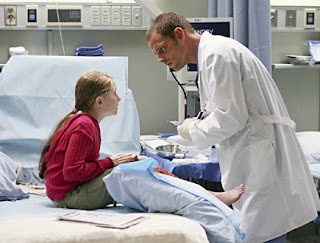
In this week's episode of Grey's Anatomy (which I happily managed to catch by a mad dash to the KL airport to catch the 7 pm flight back), the interns treated a little girl named Megan which had a (not unknown) genetic defect which caused her not to feel pain. Because she was an orphan and was bounced around foster homes most of her life, the condition went undiagnosed. She had wounds all over her (some of which she stapled with iron staples - ouch!) and through an X-ray, the doctors discovered she had serious internal injuries and bleeding. The little girl believed she had superpowers (well, not unusual for a kid to believe) - and would get into fights in school with bullies, asking them to punch her in the stomach repeatedly, since she felt no pain.


Was reminded of the book co-authored by Philip Yancey and Paul Brand, "Where is God when it Hurts", still the very best book on pain and suffering that I have read.

"It is pain that allows me to be free. When I started to study medicine I would probably have said that my purpose was to relieve pain and suffering and to save lives. Today after a lifetime of treating those in pain and those without pain I would say that my purpose is to relieve suffering and to improve the quality of life. The main difference is that then I thought of pain as an enemy, while today I think of it as a help, indeed as an important element in the prevention of suffering.

How often I have heard people complain about God when they have pain. They do not blame God for giving us a signal that tells of disease or injury, but why make it so unpleasant and why not make it easy to switch off? Now I know why. Today there are ways to switch off pain. Pain killing drugs quickly become addictive because the addict seems to be living in a problem free and pain free world."

Ya, too many of my actions and decisions are centred around pain-reduction, , without recognizing the benefit of pain in encouraging spiritual growth, whether for myself or others. Lord, please help me not to reach out for Telenol too quickly, all the time.

Monday, September 03, 2007

Japan Hour III

In recent months, I have been discovering that, for every 3 persons I know, 1.75 of them are serious Japanese anime fans. I am talking about the very non-hentai, non-manga-looking friends that I have known for months in church or at work. I have witnessed, on more than a few occasions, small groups of anime-ists huddled to together after Sunday service, animatedly exchanging silver vinyl discs and the latest anime blog news. Of these people, 0.75 of them are known to have developed a common pattern of rushing home from work and downloading anime series from those mysterious sounding websites, watching them into the wee hours of the night, while husbands are left to tuck themselves to bed, and the rest of us throw anime sheep at one another on Facebook.

Well, I am not exactly in that rapid-growing percentile of the population yet, but I do enjoy a good Miyazake film once in a while. In any case, it seemed like a great excuse to get good folks together for an evening, to use the condiments I brought back from Hokkaido a few weeks ago, and so we had the Episode III of Japan Hour at the Treehouse last weekend.

With the help of skilled tofu chefs, crab declawers and yaki grill experts, it was another cheery evening of hearty but relatively healthful eating. C&H even provided brilliant "real-time" Hello Kitty fireworks displays on their laptop which they video-ed in Uji, Kyoto. We were a tad disappointed with the anime movie chosen to be screened that night - Goro Miyazake (son of Hayao Miyazake) does have some way to go before he captures true Ghibli magic. Generally however, I think people were glad to have found new soulmates in one another and we toasted the happy occasion variously with Choya, Asahi and of course, Yakult. :)


Tuesday, August 28, 2007

Lunch-time Art Jaunts

(1) Chua Ek Kay's works are on exhibition at the SMU School of Economics Gallery from now till 12 September. I have always loved his contemporary ink work on Singapore street scenes. The SMU is very fortunate indeed to have received such a big endowment of his paintings!


(2) "Oil Painting' Photography" by Charlie Lim, at the SG Private Bank Gallery, Alliance Francais, from now till 31 August. A pretty intriguing marrying of fine visual art and photography!


(3) And finally, what I have been waiting for all year! The Singapore Watercolour Society is having it's 38th exhibition at the Ngee Ann Cultureal Building from 1st -4th September. Managed to get an invitation to the private opening this Friday. woohoo!

Anybody wants to buy a sandwich and join me for a lunch time jaunt at the galleries? :)

Sunday, August 26, 2007

Musical: <<天冷就回來 >> If there are Seasons

Surprised. At the number of songs and lyrics Liang Wenfu actually wrote for other singers, outside Xinyao. At the commendable collaboration between the "English" and "Chinese" theatre workers in this musical. And how Liang is still, after all these years, the Singapore Boy wanting to sing Singapore's own songs.

Surprised at how many of the songs were familiar to me, for I have never considered myself much of a Chinese music fan. Surprised at the memories they brought back, yet surprised how the lyrics make so much more sense now, as compared to the teenage years when I listened to them.

I bought the full anthology of Liang's songs today, if not for anything but to read those lyrics again. I think the lyrics could mean different things to different people. One could read them in a romantic way, or they could mean more than the romantic. They could be about a friend, a parent, or even somebody or something more important to the you. I guess all good song-writing has that ability - to evoke our deepest memories and feelings.


雨的氣息是回家的小路
路上有我追著你的腳步
腳下邊保存著昨天的溫度
你抱著我就像溫暖的大樹

雨下了走好路
這句話我記住
風再大吹不走囑咐
雨過了就有路
像那年看日出
你牽著我穿過了霧
叫我看希望就在黑夜的盡處

哭過的眼看歲月更清楚
想一個人閃著淚光是一種幸福
又回到我離開家的小步
你送著我滿天燕子都在飛舞

雨下了走好路
這句話我記住
風再大吹不走囑咐
雨過了就有路
像那年看日出
你牽著我穿過了霧
叫我看希望就在黑夜的盡處

雖然一個人
我並不孤獨
在心中你陪我看每一個日出

Thursday, August 23, 2007

The Study of Art

I discovered that you don't have to go to art school to learn about art history seriously. Like never before in the history of art education, there is an incredible amount of resources, both in print and online, for someone who wants to systematically study the evolution of art in history.

ok, so most of you know I am kinda nerdy when it comes to pursuing things that interest me. I like reading about the subject and listening to lectures on it. For a few months now, I have been going through the Taschen series of art books which gives the foundational knowledge of artists spanning over the entire Western civilization history. One day earlier this year, I walked into Page One and swiped all the books from the series that covered the modern period of Art History from (1890s to 1960s). It cost me the price of the very good and enduring top-end Michelin tyres that my colleague said I must get for my car. But I think it actually paid for a college year in art history.

It has been a fascinating reading journey ever since. The cool thing is that with Google Images Search, I can find almost any painting online for viewing. Of course, I would love to see some of the works in their actual galleries one day, but this is something art students a decade ago would not be really able to do. They had to travel to those galleries all over the world or rely on libraries.

Anyway, hope to share some of my favorite paintings and stories about the artists from time to time in this blog. It might be a way to discipline myself to take good notes on what I am reading! :)

Book Preview: The Panic of 1907

Waiting for this book to be launched in a few weeks' time.


Coincidentally, exactly 100 years ago, the U.S. went through one of the biggest financial crisis in its economic history - i.e. the "Panic of 1907" as it was commonly called. Two writers Robert Bruner and Sean Carr decided to write a book at this 100th anniversary giving an account of the highly dramatic events of that year. The book is expected to come out in mid-September. Little did the writers of this new book know that the events of the last few weeks would see many analysts drawing comparisons between the 1907 crisis and the current global credit turmoil.

The analysts appear to be saying that there are many uncanny parallels between the two situations. Essentially, both crises came about because of a "perfect storm" or confluence of factors, i.e. a booming economy just prior to it, an unprecedented rash of corporate mergers and acquisitions and a profusion of borrowers and creditors who overreach in their use of debt. In both instances, it resulted in "credit anorexia" amongst financial institutions, which threatens to halt one of the key cogs of the economy - debt provision.

Amazon and other booksellers are probably taking the chance to hype up the book, well, good for them. I am actually curious abou
t the book for another reason.

You see, the book is supposed to have given a good account of how one man single-handedly bailed the whole country out of a financial implosion. That guy's name is J.Pierpont Morgan, who put together probably the most famous financial rescue plan in economic history, which he basically made (or as people say, forced) all the other bank presidents at that time to sign up to. As an example of what he did during that year 1907 - at one point of the crisis, the New York Stock Exchange was threatening to close down in the middle of the trading day, Morgan essentially prevented a complete meltdown of the capital markets by announcing that he would underwrite a $30 million bond offering (equivalent to $900 million in our day) for the stock exchange.

There are some who even said he engineered the financial crisis in the first place so as to profit from it eventually. Well, if he did that, he certainly made the most colossal gamble that any person dared to make. In any case, after the crisis, he did make a huge amount of money and spawned the creation of many of the key financial and corporate institutions we know of today, e.g. GE, Morgan Grenfell, US Steel, Exxon etc.

I have always been quite fascinated with the man even before I had anything to do with one of his legacy institutions. When travelling in New York some years ago, I came across the House of Morgan (23rd Wall Street), built at a mere 4 storeys amidst the towering blocks around it, which was meant to demonstrate the economic prowess of the man and his institution at that time. There is also the incredible Morgan Art Musuem, which houses one of the most amazing art collections ever (lots of famous paintings, original scores of Beethoven, Mozart, and even a whole roof of a French castle). There are many colourful stories about the man. He was apparently very strange and enigmatic - reticent, all-powerful and demanding perfect authority.

One question that has been asked is who will be the "Morgan" of this crisis (if it does become a true one)? Some say it will be the central banks, who have been pouring in giant amounts of money into the system in the last two weeks. Some say you do need a real "Morgan", since it is about restoring confidence, and a human person putting his own capital at stake is always going to be more convincing than a faceless central bank system. One writer says it may be Warren Buffet, who interestingly, indirectly owns 19% of Moody, a rating agency who may have caused some of the subprime debt issues in the first place.

All pretty interesting to watch and read. Of course, I do hope things to become stable soon. In the meantime, I am actually kind of glad for the time and opportunity to learn a bit more about all these new financial products and systems that were identified to have triggered the situation. While the markets are hot, nobody cares to really explain it to you (and you are busy yourself with the ride). I was surprised to find that there's much good literature out there that tries to explain the issues. That is necessary and good. Afterall, the crisis is partly about Fugu Fish hedge funds selling collateralized debt packages to the Moms and Pops and Auntie Wongs of this world who may not fully understand what goes into them.

Tuesday, August 21, 2007

Evening Run


The Trees look different from the day.
(More beautiful methinks)
They stand
quietly by, like dear grandparents,
as I run past them at night.

Monday, August 20, 2007

Facebook

Yes, I am finally on it, after months of coy declining of invitations from cyber-resident-happy-friends. It was more out of curiosity than anything. After reading the Wikipedia entry, and being pretty fascinated with discussion on Facebook as a social phenomenon, the intriguing legal suits surrounding intellectual property rights, and the bidding war between giant private equity funds for a stake in Facebook, I was curious enough to finally give in to a friend's cajoling and joined it just before the weekend.

I was promptly Thrown Sheep and all manner of cattle offal, and have been engaged in Food Fights ever since, but I do want to report that it is as much the amazing phenomenon that people have been talking about.

I must say the idea of self-added applications (AIP) is a very clever one - it was pretty cool seeing the bursts of creativity coming from all corners of the cyberworld. And I think it is the best kind of creativity there is - i.e. garnered from the general pool of human knowledge/resource (just like the cool Photosyth technology I blogged about a few weeks ago) and engineered with the clear purpose of human application.

And of course, the biggest boon is that I am connected to some very good friends in another way now (even though not all my social circles are represented on my Facebook - for example, I noted with amusement after a quick search that NONE of my classmates from my junior college humanities class were on it - computer dinosaurs as most of us tended to be. Hello there JC friends, it is not as scary as it seems, really! :)) .

It has been especially good to hook up with those many friends who live in Hong Kong and elsewhere in the world that I don't often get to see. It all suddenly dawned on me why I have felt for a long time it is quite challenging to keep up with these overseas friendships. Even though there is email and instant messaging, it is not always possible to keep up constant interaction with these friends because of different timezones and the crazy work schedules that people have.

From that, I am now beginning to recognize that the essence of most friendships is made up of just as much "Talk" as "Play". And of course, Facebook is about "Reclaiming Play". The friendly banter and silly games takes place in parallel with the more serious private one-to-one conversations. But this is exactly as happens in real life! I was quickly reminded of all the crazy raucous goofing around that used to take place within my HK circle, the stuff that formed the bases for many deep life-long friendships from there....

If you came to know this blog through me, you are probably already a Friend or someone that would be able to find me on Facebook through my real name. Be warned though, my favorite activities are Headbutting and drawing Graffiti on people's Walls. :)

Thursday, August 16, 2007

No Mere Mortals

A rather heavy heart tonight, do want to pray but find it difficult to start. It's worse because one knows exactly why. An email, a phone call this afternoon made me realized how little I can really care about the golden commandment. Back home after DG, I flipped almost involuntarily to this passage in C.S Lewis' classic essay which I have read so many times in the past, but which strikes the conscience sharply every time:

"It is a serious thing to live in a society of possible gods and goddesses, to remember that the dullest and most uninteresting person you talk to may one day be a creature which, if you saw it now, you would be strongly tempted to worship, or else a horror and a corruption such as you now meet, if at all, only in a nightmare. All day long we are, in some degree, helping each other to one or other of these destinations. It is in the light of these overwhelming possibilities, it is with the awe and the circumspection proper to them, that we should conduct all our dealings with one another, all friendships, all loves, all play, all politics. There are no 'ordinary' people. You have never talked to a mere mortal. Nations, cultures, arts, civilisations -- these are mortal, and their life is to ours as the life of a gnat. But it is immortals whome we joke with, work with, marry, snub and exploit -- immortal horrors or everlasting splendours. This does not mean that we are to be perpetually solemn. We must play. But our merriment must be of that kind (and it is, in fact, the merriest kind) which exists between people who have, from the outset, taken each other seriously -- no flippancy, no superiority, no presumption. And our charity must be a real and costly love, with deep feeling for the sins in spite of which we love the sinner -- no mere tolerance or indulgence which parodies love as flippancy parodies merriment."

--C. S. Lewis, From The Weight of Glory

So easy for me to say : "Love Thy Neighbour". How many times have I chosen to love those only who are more interesting, more beautiful, more happy, or those who can love me back. So easy to procrastinate a phone call back to a lonely faraway friend, to hasten a boring conversation, ignore an email, and avoid the funny-shaped sheep of Christ.

But for the help of God, it is impossible to love.

Wednesday, August 15, 2007

Invisible City

Conversation at Billy Bombers (over overly-sweet milkshakes) after watching Tan Pin Pin's documentary "Invisible City" :


EC: "So what do you all think of the movie? You all like it?

All: "I like!" "Not bad" "I like Singapore Ga-Ga better leh." "A qualified No"

(i.e.various responses)

E.C: "What do you all think it is about?"

SomeBody Who Read The Review: "It's about history-both national and personal, and attempts to preserve the seldom spoken parts of it. It's also about memory and the atrophy of memory."


(Conversation then proceeded to recount the things in the past which we no longer see today, including snail-mail pen pals, IRC chat rooms, typewritten school assignments, the kok-kok noodle man. LKP won hands down with his account of the night soil collector who visited his estate up till the time when he was 10 years old)


Me: Will there really be an invisible city in 50 years time? I mean, with the internet, digital photography, personal blogging, electronic storage, everything can be and is being archived for posterity.

E.C.: I think there will definitely still be an invisible city. There will always be people who will keep their memories and private to themselves.


LKP: There will also be those people in society who are marginalized or repressed, who may not find a voice at all despite this state of technological advancement.

Me: That's probably true. I guess preserving history is not the same as preserving the experience of people who lived through that history. Sometimes we ourselves don't remember what happened, even though we have photographs or films depicting the past.

E.C: Ya. Commentary is key. That's why the Ivan guy said he included personal commentary for his old film footage! Other people won't have a chance of knowing what in the world they were about otherwise!

Arrow (ex-government officer) : Anyway, you think our National Archives really keep everything? They destroy records after a certain time you know?

All: "Really ah?!"

Arrow: "Ya lor! That's why the old guy said he didn't like the National Archives mah!"

*************************************

To me, Invisible City is about ordinary people trying to make a mark about their existence, or the existence of something else important to them. Anything that exists, must be reasonable, so saith Hegel. So to be of reason, one must exist, and be visible in some form, even if only to oneself.

Tuesday, August 14, 2007

A Week in the Studio

"Contentment"
(Watercolour on cold pressed paper. Full poster size.)


"Through a Scanner Darkly"
(Watercolour on Arches paper. My favorite of the week.)

"Sumi Crane"
(I tried this for fun with leftover paper and dark paint, but it was probably the most difficult piece out of the whole lot, I was perspiring after 2 minutes! It sure makes one appreciate the Chinese paint masters! Got a Chinese seal of my surname made for $30 at Chinatown.)


"Bukit Timah Forest Leaves"
(This is fast becoming my favorite subject. There are a million pictures that leaves can provide. I need a better camera to take these photos though.)

"Some Corner of Malacca"
(Quick Pen and Wash done under an hour.)

Saturday, August 11, 2007

Next Stop Ueno

Four trips to Tokyo in the last five years, the sprawling city is starting to gain a certain familiarity, which usually happens when one location within it becomes a point of reference, in this case the cool designer Andon Ryokan in Minowa, which we went back again this year to stay.

Funny how cities like Tokyo can become so familiar and yet remain an effort to get to. Anyone who's been there would know what I mean. There's only one hour time difference between Japan and Singapore, but it is a solid 7.5 hours plane ride from Singapore to Tokyo. When you land at Narita, there is a longish train ride into the city that takes at least an hour. Door to door, you are talking about nearly 12 hours of travel time to get there.

One banker that I travelled together with recently commented that the greatest cost of doing business in Asia is the amount of travel time from city to city. Many of the investment banks are trying to figure out how to cut short that time, including using private jets or corporate time sharing of aircrafts. But he says these methods are still prohibitively expensive. Apparently it costs $50,000 to make a private landing at Narita. And somehow, I just don't see the CEOs of Morgan Stanley, Goldman and Merrills all sharing a private plane to go for a competitive beauty parade in any city at the same time.

Last Monday afternoon, while sitting in the subway train going from Tsujiki back to our ryokan in Minowa, and anticipating the long drawn travel route back to Singapore that evening, Agent M quipped, "You know, I am really not looking forward to the plane ride back. How nice it would be if the next stop was Clementi, and then Bishan." Sitting in that now-familiar Tokyo train, it seemed dreamily possible that we could be conveyed to our own doorsteps without further ado. It would be great if travel one day really got that efficient, and we could just take the MRT to eat sashimi uni in Tokyo when we got off.

Thursday, August 09, 2007

Art Books Kinokuniya

Did you grow up in the 70s? If so, did your mother make clothes for herself and the family using Japanese dress pattern books like this?


My mom did. I was always curious why those pattern books were invariably in Japanese. My mom did not read Japanese, how useful did she really find those books? Why could she not get those books in Chinese or English? It was one of those childhood puzzles that I don't think I ever solved.

But then last week, while visiting the Tokyo Metropolitan Art Museum, I came across these books in the museum shop, which had an unusual array of art instruction books and even art supplies.


I bought a rather big bunch of these, and am pretty excited about the new "discovery" - Japanese art instruction books were inexpensive (compared to the ones from the US and Europe sold here) and were very detailed in terms of pictoral representations (which is helpful since I don't read Japanese!) Best of all, they had an "oriental" slant to the painting styles, i.e. clean and less fussy than the traditional Western methods, which is personally an appealing thing to me.

Another section to explore at Kinokuniya! :)

Inside Studio Ghibli

My favourite part of the Ghibli Museum in Mitake Tokyo was definitely the two "preparatory spas" which re-created Miyazake's work studio for his early career. They were more like personal studies of an individual, with personal collections of the artist's books, music and of course sketches and paintwork. The museum was styled in a way that allowed visitors to touch and handle the personal artefacts in the rooms.


It confirmed one thing that I have always believed about great artists - their interests are always extremely broad. You could tell from the books (both Japaneses and foreign language) that were in Miyazake's studio - everything from children's and classical literature, to architecture and even engineering. There were books on botany, insects, trains, ships and aeroplanes. No wonder his animation work is so full of delightful nuances and details, a product of wonderfully curious mind!


Just spent N-Day afternoon re-watching some of the Ghibli collection, including Totoro. The more I watch Miyazake's stuff, the more I see his (and his studio workers') sensitivity to both to art and character development. The setting in each movie is like a beautiful, lovingly crafted art canvas on which people and magical creatures come to live. His characters are never simple, the storyline always profound and wildly imaginative. It's a shame that kids (and adults) in another part of the world have to be satisfied with Walt Disney, at best Pixar.

Tuesday, August 07, 2007

Sunflower Land

Yep. Hokkaido is as pretty as people say it is. :)

It is quite amazing how one week of doing nothing but roaming in flower farms, soaking in onsens and eating an undefined number of ethereal cream puffs did do to get rid of the effects of the past crazy months at work.

Sunday, August 05, 2007

On the Sixth Night - Waking


"That first green night of their dreaming, asleep beneath the Tree,
God said, "Let meanings move," and there was poetry."

- Muriel Rukeyser, "Selected Poems," 1935

(oil on canvas, 8 x 11, impasto trial of a tree at night, using phthalo blue straight from the tube, ouch. "vincent" must have been more generous than people make him out to be)

Friday, July 27, 2007

Storm Chase


While doing some research on Hokkaido last night (yay, yay, going there in a jiffy!), I came across this freelance photographer whom I thought was quite interesting. The confluence of competing interests that he has (international politics, storm chasing and Japanese anime) makes for a fascinating portfolio with a fusion global feel. His Flickr Link here.

Thursday, July 26, 2007

Hotel Room


One of my favorite Edward Hopper paintings - Hotel Room (1931)

Seven years ago on this date, I sat in a small hotel room in Wanchai Hong Kong with two suitcases, alone, going through the list of things I needed to do to set up a new life in a new country. Renting a flat, opening a bank account, getting a mobile phone line.

I had left Singapore at that time as newly qualified lawyer to chase a dream of most young lawyers at that age i.e. to work in an international firm, a "magic circle" law firm, in one of the financial capitals of the world. I took almost all my savings with me (just over S$10,000) converting them to Hong Kong dollars. More than half of that sum was used within the first week in Hong Kong to pay the deposit for a rental apartment there. I knew only one or two people, had no idea where to go find a church or a Christian community. I also did not know how long I was going to be there, since it was not a posting. Maybe two years, maybe a much much longer time.


It is hard to believe that 7 years have gone by. I have been back home in Singapore for more than a year now. Sometimes those years seemed like a dream and quite far away. But those years had a profound impact on who I am now - professionally, socially and spiritually.


In many ways, life there was not what I had expected it to be when I first went. Work-wise, I always though I thought I would build my career in a law firm, but I was instead led mid-way to a financial institution where I still am. I thought I would witness the giddy financial prowess of Hong Kong, but in fact I saw the city struggle through very difficult times (SARs and all). I thought I would become a China specialist, and travel frequently there on business, but instead my "work" in China took on an entirely different nature.


I thought I would meet many people like myself, and lead the quintessential expat life of Lan Kwai Fong parties and cross cultural networking. Instead, for the first time, I discovered I was an introvert, and did not mind hanging out with just a couple of good friends every weekend, and that I loved having my own living space (for the first time), and would spend many hours reading and thinking in my own flat.

Spiritually, it was a dry time at first. I kept comparing the church there to my home church in Singapore. I found the preaching at the international church too simple. The congregation was too American. I did not bother to join a cellgroup, because of my newfound love for solitude. It was only after the first year that God took away the sides of the box that I put myself into. Through a series of very deliberate (and often humbling) events, God made it clear that the purpose of putting me in Hong Kong was not for the promise of a high flying career or an exclusive expat life, it was to stretch my mind and heart in ways that I never did imagine.

There are so many memories from that era. So many important people that came into my life and made their impact. Best friends made for life. So many experiences that shaped the way I look at things now - work, money, relationships, family, church.


So to that first memory of a lonely Wanchai hotel room, many other images were added which now form my recollection of that period. My small rented apartment, and the many intimate dinner gatherings with dear friends held there. The Happy Valley caregroup meetings, a room filled with people from more than 10 different countries teaching and learning from one another. The weekend trips to Shenzhen bringing just the gospel and taking away the joy each time of a growing harvest. Learning a new language Cantonese which opened up the mystery of the local community for me. Working with the best brains in the industry but realizing once and for all that money, not matter how huge the amounts, would not make a place home for me.


I guess people go away to another place for different reasons. Many leave for work and a better future. Some to get away from the same-ness of home. Some leave to escape a bad relationship, or in search of a good one. Most would say, "just for the experience".

A young galfriend of mine in church shared with me about her thought processes in deciding whether to go to Beijing for a posting. She was concerned about what it would mean for her career and more importantly her spiritual life. She said she was not sure if she would be able to find the same spiritual community there. The same questions that I asked as a twenty-something. I could only tell her that whatever she is expecting or not expecting now, it is likely to be very different when she actually goes there and lives it out.

The important thing to remember, my friend, is that God's love is extra-territorial in every way and the only way to find out is not to be afraid to go when He calls. It could be a different country, a different job, a different station in life. The only purpose He has for changing our circumstances is to stretch us so that we can understand His love so much better.