Showing posts with label Art. Show all posts

Wednesday, October 10, 2007

Inspired

I am very very inspired by the A-Painting-A-Day (PAD) movement that I came across recently on the Internet. The PAD movement was started in 2004 by artist Duane Keiser who has revolutionalized the way art creation is brought to the masses. Essentially, the idea was that artists, (both professional and hobbyists) can make it a discipline to create a painting every single day of their lives. The original story can be found in this USA Today article.

Yep, every day.

It did seem like an impossible thing to do, but it is amazing to see how there are in fact hundreds and thousands of people out there who are actually doing it. Including people with full-time jobs and children, who is making it a point to create small sized paintings (usually no bigger than 6'X8' postcard sized works). It is very exciting to view their blogs and see how their work really did improve over time. More importantly, many of them attest to the fact that it has improved their "seeing" skills tremendously, because in looking for something to paint everyday, they have had to train their perception skills, and pick out interesting subjects in their everyday lives.

Check out these sites.

http://www.dailypaintersguild.com/


http://duanekeiser.blogspot.com/

There are literally hundreds more. It's exciting every morning to open the the guild pages to find out what new wonderful creations these daily painters have made the day before.

I have gone out to buy those mini blank canvases. Maybe one could start with the PAW (a Painting-a-Week) movement. :)

Tuesday, August 28, 2007

Lunch-time Art Jaunts

(1) Chua Ek Kay's works are on exhibition at the SMU School of Economics Gallery from now till 12 September. I have always loved his contemporary ink work on Singapore street scenes. The SMU is very fortunate indeed to have received such a big endowment of his paintings!


(2) "Oil Painting' Photography" by Charlie Lim, at the SG Private Bank Gallery, Alliance Francais, from now till 31 August. A pretty intriguing marrying of fine visual art and photography!


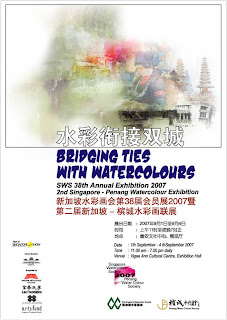
(3) And finally, what I have been waiting for all year! The Singapore Watercolour Society is having it's 38th exhibition at the Ngee Ann Cultureal Building from 1st -4th September. Managed to get an invitation to the private opening this Friday. woohoo!

Anybody wants to buy a sandwich and join me for a lunch time jaunt at the galleries? :)

Thursday, August 23, 2007

The Study of Art

I discovered that you don't have to go to art school to learn about art history seriously. Like never before in the history of art education, there is an incredible amount of resources, both in print and online, for someone who wants to systematically study the evolution of art in history.

ok, so most of you know I am kinda nerdy when it comes to pursuing things that interest me. I like reading about the subject and listening to lectures on it. For a few months now, I have been going through the Taschen series of art books which gives the foundational knowledge of artists spanning over the entire Western civilization history. One day earlier this year, I walked into Page One and swiped all the books from the series that covered the modern period of Art History from (1890s to 1960s). It cost me the price of the very good and enduring top-end Michelin tyres that my colleague said I must get for my car. But I think it actually paid for a college year in art history.

It has been a fascinating reading journey ever since. The cool thing is that with Google Images Search, I can find almost any painting online for viewing. Of course, I would love to see some of the works in their actual galleries one day, but this is something art students a decade ago would not be really able to do. They had to travel to those galleries all over the world or rely on libraries.

Anyway, hope to share some of my favorite paintings and stories about the artists from time to time in this blog. It might be a way to discipline myself to take good notes on what I am reading! :)

Tuesday, August 14, 2007

A Week in the Studio

"Contentment"
(Watercolour on cold pressed paper. Full poster size.)


"Through a Scanner Darkly"
(Watercolour on Arches paper. My favorite of the week.)

"Sumi Crane"
(I tried this for fun with leftover paper and dark paint, but it was probably the most difficult piece out of the whole lot, I was perspiring after 2 minutes! It sure makes one appreciate the Chinese paint masters! Got a Chinese seal of my surname made for $30 at Chinatown.)


"Bukit Timah Forest Leaves"
(This is fast becoming my favorite subject. There are a million pictures that leaves can provide. I need a better camera to take these photos though.)

"Some Corner of Malacca"
(Quick Pen and Wash done under an hour.)

Thursday, August 09, 2007

Art Books Kinokuniya

Did you grow up in the 70s? If so, did your mother make clothes for herself and the family using Japanese dress pattern books like this?


My mom did. I was always curious why those pattern books were invariably in Japanese. My mom did not read Japanese, how useful did she really find those books? Why could she not get those books in Chinese or English? It was one of those childhood puzzles that I don't think I ever solved.

But then last week, while visiting the Tokyo Metropolitan Art Museum, I came across these books in the museum shop, which had an unusual array of art instruction books and even art supplies.


I bought a rather big bunch of these, and am pretty excited about the new "discovery" - Japanese art instruction books were inexpensive (compared to the ones from the US and Europe sold here) and were very detailed in terms of pictoral representations (which is helpful since I don't read Japanese!) Best of all, they had an "oriental" slant to the painting styles, i.e. clean and less fussy than the traditional Western methods, which is personally an appealing thing to me.

Another section to explore at Kinokuniya! :)

Sunday, July 15, 2007

A First Paintbox

After three visits to Art Friend in the last week, I finally put together my very first oil paintbox.


Everything is bigger and heavier for oil painting than for watercolors, so a sturdy paintbox is a must. I like my new elmwood wooden box. :)

A whole new world to be discovered soon. Am excited.

Friday, July 13, 2007

A Walk in the Woods

What to paint, what to paint? ...

... Look no further than under the feet.

Tuesday, July 10, 2007

A First Portrait

Back to The Simple Life. Term has started again in art school. The first two lessons are a warm-up, so it is back to charcoal drawing again, before we start on oils next week.

A first old person portrait.


hmm... oil painting materials are kinda bulky, what with the easel and canvas and all. I think I have run out of space again at home. I so wish I had an extra room to use as a studio. Maybe convert the balcony? But where then to hang the laundry? ponder ponder...

Wednesday, June 27, 2007

Impressionistic Poem


1(a


le
af
fa
ll

s)
one
l

iness


Left: e.e. cummings' impressionistic poem titled "1(a...(a leaf falls on loneliness)" (1958)

Right: trying out oil pastels last night on noir paper (an impressionistic leaf)

Monday, June 18, 2007

An American Favorite

I don't think I could ever get tired of looking at Norman Rockwell paintings.

Whenever I am in that mood, I love spending an evening alone (like tonight), snuggled in my couch (Copland or Gershwin music playing in the background) poring over the Norman Rockwell artbooks which I had lugged back from the Norman Rockwell Museum in Stockbridge Massachusetts three years ago. I personally don't think there is a better or more enjoyable way of learning about American history or the psyche of its people at that time than looking at and reading about Norman Rockwell's paintings.

Norman Rockwell is of course famous for his depictions of American life in the world war and post-war years. The Saturday Morning and Evening Posts cover has become almost synonymous with American illustrative art in the 20th century. There's something about them which a Times magazine photographer now might find hard to replicate.


This is a master storyteller. Here are a few of my favorites.

Going and Coming (Saturday Morning Post cover, 30 Aug 1947)
The details are amazing here. The top picture shows an enthusiastic family going for a boat trip in the morning, the bottom picture a much more fatigued group. Notice the perfect knots that tie the boat in the top and the frayed ropes at the bottom. Only grandma remains unchanged.


The Gossips (Saturday Evening Post cover, March 6, 1948)
Each person here was a real life model from Rockwell's neighborhood in Vermont. They had no idea that they would be part of this depiction of America's favorite past time! Rockwell added himself and his wife Mary in the picture to take the sting out of the commentary.


The Marriage License (1955)
This is one of the saddest paintings I have ever seen. I stood in front of it for almost 20 minutes at the Stockbridge museum when I first saw it. It is based on a real incident that happened in the town that Rockwell lived in shortly before he painted this. The marriage registry clerk in the painting had just lost his wife a few weeks ago. Notice the cigarette butts on the floor, and the cat which looks like it has not been fed for a while. The clerk's posture is
in contrast to the hopeful stance of the newly wed couple in the picture.


Saying Grace (1951)
This one tells of a rare moment in American history where the faithless wonder about the Faith.


ok, I will stop posting now. But there are so many wonderful stories to tell through through pictures.

Sunday, June 10, 2007

Documenta 1-11

We went to the very (literally and figuratively) cool National History Museum today to visit the travelling archives exhibition of Documenta.

Documenta is one of the most important contemporary art exhibitions in the world today. It is held once every 5 years in Kassel, Germany. I don't think I will be able to make it for the one to be held there this summer, but it was kind of cool to see their archives for the past 11 exhibitions at the NSHM. It's like seeing modern art and world history compressed in 5 year time capsules.

Now on till 31 July 2007 at the National Museum. It's free. :)

Thursday, May 31, 2007

Writing about Music is like Dancing about Architecture


And so it was a good relaxing weekend of interesting film, music, food and hanging out with life's best friends. We had a DVD Double Bill screening of "The Immortal Beloved" and "Sketches of Frank Gehry" on Saturday. The movie screening times were a bit off from what was originally scheduled, as the darling motley crew (plus a dog or two) trotted in and out of the Treehouse at various times. But it all proceeded and ended rather well, with not too much leftover food at home, or even at Macpherson hawker centre where we ordered more than $20 worth of Ngoh Hiang for supper (so much so that the Uncle there had to make sure he counted the right number of plates for us. heh).

That night, after consolidating the bags of leftover chips in the house, I sat at the laptop and did the usual wikipedia-ing of the various questions that flashed through my mind while watching the movies that evening, for e.g.:

Did anyone finally find out who Beethoven's "Immortal Beloved" was? Did no one get his inheritance? How much did he leave anyway (I thought most composers died poor)? Why did Beethoven insist on conducting his works even though he was stone deaf?

As for the Gehry documentary, one might have wondered:

What was Frank Gehry's real (Jewish) name? What sort of anti-semitism did he really face in America in the 50s? And who was the "Maggie" for whom he designed this astonishingly simple but beautiful Maggie's Place (cancer healing centre) in Dundee, Scotland?


There's much information and theory out there, and most of it pretty intriguing stuff. I was also rather pleased to find the full transcripts of the movies online.

But that night, I randomly came across a startlingly relevant quote by Duke Ellington that summed up my personal response to both movies almost perfectly:

"Writing about Music is like dancing about Architecture."

I think it's true. There are some artforms where it is hard to write or even talk about them to someone else concerning their impact on yourself and to do full justice to their greatness. Music (especially classical?) and Architecture seem to me to be two of them. You can read great literature on paper (of course), and look at great paintings online (sort of). But to appreciate great concert music, you must go listen to it in a concert, and to appreciate architecture, you must go stand in front of the building. That, I think, is part of the reason why one was also likely to be a little disappointed watching a movie about a composer or an architect. A 2-hour long drama, one soundtrack (a good one though it was) and a 32-inch TV in a living room could only do so much.

Last week, in my brain-fried state, I
blogged about how the film Sketches made me less inclined towards the architecture of Gehry than before I watched it. I think I know now why I felt that way - I was looking for an exposition of the creative processes that Gehry went through in his design, which the film did not (and probably did not set out to) achieve. I was curious to see how he developed his architectural ideas from his famous sketches, and how he would incorporate principles of form, composition and utility into his plans. In other words, I wanted to learn about the nuts and bolts (i.e. "science") of how you turn an artistic idea into artistic reality. But that was what the movie did not do for me.

Instead, the movie largely followed a more common approach taken by directors of these types of films, - i.e. even though it alluded to some of those artistic processes, the film seemed more interested in preserving the romantic, mysterious idea that it was, at the end of the day, all about "talent" in a few gifted individuals like Gehry. In the words of Milton, Gehry's psychotherapist who was interviewed in the movie: "...other architects have come to me, but I tell them that I can't make them into Gehrys because they do not have his talent. You can open the floodgates, but then if there is no flood behind ..." I kept wondering if Gehry really agreed with that portrayal, and if he was not embarassed when the script required him to say in the movie that he built the Disney Concert Hall after looking into his wastepaper basket at the intriguing shapes of trash in there.

Now, for anyone who has attempted to pursue any of the artforms (whether as a professional or even as a casual hobbyist), he or she would know that much of that pursuit involves the plain ordinary hard work of figuring out how sounds, colour, light and chemicals interac
t in this material world. For instance, one does not "become" a great painter. Van Gogh had to take a class in perspective drawing (before that he thought drawing was pure luck or witchcraft). Gershwin had to put himself through a orchestral composition class even after he wrote his cool Rhapsody in Blue. And me, the once-a-week art student, still has has a long way to go in figuring out the chemical formulae on my paint-tubes in order to discover the 2,500 colours that I should be able to obtain from the standard palette of 9 pigments, all of different translucencies, grain and tone.

I came across
a local photographer introduced to me recently, and I appreciate how he honestly and unashamedly admits that, whether while taking photographs for clients for a living or in pursuing his own art, he says - "I work my ass off".

Anyway, back to the two movies. Suffice it to say that I still have absolutely no idea how a music composer or an architect work their craft. But what I did appreciate very much about both films, and was deeply moved by, were the glimpses into the inner worlds of the protagonists. I went away feeling the poignancy of two men, two artists, each of whom was caught in that struggle of wanting to be "the nice guy" (or to be loved), seeking perfection of themselves, and wanting to change this world by pushing its limits with Art.

(Now playing: Second movement of the "Emperor" Concerto, by Ludvig van Beethoven.)

Wednesday, May 09, 2007

Painting: "Wall Textures"

This is a mixed media watercolour painting by contemporary Australian artist John Lovett, whose specialty is bringing out textures in buildings. When I was in Hanoi, I kept thinking how much he would enjoy and be able to capture the interesting historical buildings landscape there.

Just bought another bunch of his DVD demonstrations online. I think I will drop an email to him to suggest the Vietnam idea. Afterall, he organizes painting tours in Australia and Europe, so why not Vietnam? It's a shorter flight from downunder, and I am sure it will be well-received by art students.

The other thing that I kept wondering about in Hanoi was why there were no watercolour works there, only lots of oils. To me, Vietnam is a genteel, subtle and ephemereal country, inextricably tied up to lakes, rivers, and the sea. I can think of no better medium than watercolurs to capture that spirit. Hopefully more watercolorists (both local and international) will start painting there.

"For me, the unpredictability and uncontrollable nature of watercolor make it the most exciting and expressive medium of all. The opportunity to meander somewhere between mastery and complete lack of control during the course of a painting make it one of the most engaging mediums." - Lovett

Monday, May 07, 2007

Art in a Chair

(a poem written after the earlier post titled Art versus Life which discussed the use of chairs in the modernist artwork of George Brecht)

To create some art everyday
One could make a daily resolution to:
Draw a one-minute sketch a day
Jazz up an old tune on the guitar
Write a poem (like now)

Or
I could sit in a chair
and do any of the following:
Eat a bowl of ramen in Tokyo
Write a Vietnam law reform report
Call mom about her back pain
Tell someone a happy story
Listen to the friend beside me
Recount a sad thing
Pray
Or, fall in love with you
In front of me

And live Life, as Art
All in a chair.


(Picture: "Chair with a History", George Brecht, Cologne, 1966)

Saturday, May 05, 2007

The Art of Copying

"The Singing Butler" by Jack Vettriano, is probably the most famous and infamous modern painting we know.

Here are some rather remarkable facts about it:

(1) The original canvas painting was sold for £ 774,000(!) in 2004, even though when Vettriano first submitted it to the Royal Academy of Art in 1992, it was rejected.

(2) The Singing Butler is the most widely reproduced painting in history, beating even Van Gogh's Sunflowers, and Monet's Sunrise. Vettriano receives £ 500,000 (!!) a year in royalties from the reproductions, which can be found in prints, bags, mugs and pillowcases etc.

(3) Vettriano's works have been sold to celebrities like Jack Nicholson, composer Sir Tim Rice and film maker Coltrane. Even the Queen of England buys his stuff.

(4) Vettriano is a self-taught artist who used to work in a coal mine in Fife Scotland, and only picked up painting in his twenties when his girlfriend gave him a box of watercolours as a gift.

(5)In Oct 2005, it was 'discovered' that figures in some of Vettriano's paintings, including The Singing Butler, were based on figures from an artists' reference manual, The Illustrator's Figure Reference Manual.

Reading about Vettriano and his works always brings up many questions relating to "What is good Art?". The debate surrounding this artist still rages while he collects his millions. During my recent Vietnam trip, I was thinking a bit about that question again in a somewhat similar context. If you have visited the Old Quarters district of Hanoi City, you would have noticed many "art" shops (not the galleries) selling reproductions of local and international paintings. There is often a row of artists, each perched on a short stool in the shop, copying famous paintings in oil from little postcards or art reference books. Dali, Botero, Renoir, you name it, they copy it. Now, they are of course doing that for a living, and are not really claiming to be artists in any way. We do know however that many of the popular artists in Vietnam started out their art career this way. Some of them have done very well indeed, attracting an international clientele (including the likes of Bill Clinton) who are taken by the colourful, fusion style that now characterizes much of Vietnamese artwork. Critics of the local art however, find it overly-stylized, commercially driven and lacking in creativity. Some have even said that they are essentially copyists of the original successful Vietnamese artists like Duc and Bui .

It was quite amusing to see "The Singing Butler" being copied in the artshops in Hanoi. A copy of a copy! hahaha... Supporters of Vettriano would say, "Get a life, stop being an art snob!". They will point to the fact that Vettriano is able to arrange and compose his pictures in such a way (even though he may not have originally come up with the figurine drawings) that evokes mystery, romance and strong emotional response from his viewers - that ability justifies him to be recognized as a great artist. Detractors on the other hand would reject it as plagiarism, artistic dishonesty and call him not an artist, but a mere "colour-filler".

I know which "camp" I belong to, but I think checking one's response to a piece like "The Singing Butler" is useful to discover one's own attitude towards art - what is it that we admire and respond to, and the way we ourselves will go about creating art.

Friday, May 04, 2007

Painting: "After the Church Service"

This is a painting by one of my favourite artists, Mark Stewart. It is called "After the church service in South Carolina". I love so many things about it. The way the louvred church building wall catches the sunlight, and how the long thin shadows suggest a tall-wooded neighbourhood. It also makes you wonder about the connection between the man and the church. Did he just come out of the church service? From his dressing and appearance, he looks like he is of a different ethnicity, or even a different faith. Certainly his posture suggests that he does not have (or want to have) too much to do with the church that he is walking by.

Did I mention that I love the light in the painting? This is why watercolours are so wonderful. It creates light in a way that no other medium does.

Saturday, April 28, 2007

Art versus Life

"Art is not the most precious manifestation of life. Art has not the celestial and universal value that people like to attribute to it. Life is far more interesting.: - Tristan Tzara


While visiting the Modern Art Musueum of Barcelona (MACBA) last year, we had the chance to see a rare exhibition of the works of George Brecht - a reclusive American artist from the Fluxus movement of the 1960s, who has since for the last 30 years been based in France, hardly ever publishing or exhibiting his work. He is however, still considered one of the most important artists in the contemporary world. It was a fascinating exhibition, and for me, and important milestone in learning to appreciate modern art.

One aspect of Brecht's word holds special interest for me - the idea of "participation" in art. He believes that art does not exist in isolation from life. In fact, art is nothing and meaningless, without it being evolved at the very same time as life, no matter how mundane that life was. In this he was heavily influenced by musician-composer John Cage, who of course was famous for "participatory" composition in music.

Brecht is famous for his artwork relating to chairs - a mundane, ordinary domestic object. In relation to his first "chair exhibition" in Cologne in 1966, he said: "In Rome I bought a very simple wooden chair and a very beautiful book bound in red leather. I began to note down in the book where I'd bought the chair, how much I'd paid for it and where I'd found the pen I was writing with and the kind of ink I was using and so forth. Then I exhibited the chair and the book and everyone was invited to add to the book whatever was happening while he was sitting on the chair".

And so, completely against the idea of "canonization of art", viewers of the early exhibitions of Brecht were allowed to touch and modify the exhibits. Needless to say, haha...things got stolen or damaged, and galleries stopped allowing people to participate in the art, a fact greatly bemoaned by Brecht and a possible reason why he decided to lead a reclusive life.

Part of the exhibition at MACBA that we attended included three empty chairs placed throughout the musuem. I am sure Brecht would have loved visitors to sit on them and create whatever art in doing so. Travel Buddy tried to sit on them while the musuem guards were not looking. He managed to sit on two of them, I even managed to photograph these two art events on flash memory. But the third yellow one was up in the balcony which was closed off for renovations, so there was no participation of art there.

So I have been thinking quote a lot about the idea of art and life recently again. Sometimes, I wonder if I might live with regret about not being really able to pursue the creation of art in some form. But maybe what is more important is to make sure one actually lives life.

Wednesday, April 25, 2007

Pouring Light on Rust

Came across this Malaysian artist - Lok Kerk Hwang - recently and am quite impressed with his works. The work is very luminous and brings interest to the very mundane and everyday objects that he paints. How mundane? He has a fantastic series of paintings called "Symphonies of Rust" - depicting metal trays, gas tins, metal hooks etc.


Some of the scenes that he paints on Batu Pahat are especially endearing. I did have my earliest memories there, living with grandma.

Wednesday, March 28, 2007

The Simple Life Part I - Body Parts

(Note: The images that follow may cause discomfort in some blog readers)

So, like I mentioned in the last post, I have been busy in the past few months leading The Simple Life. One good part of it is to with finally signing up for part-time art school at NAFA. It's been something I have been wanting to do since - what? - university days actually. But law school, after that pupillage, and then starting out in practice made it seem like an impossible thing to do. I could have done in Hong Kong, I guess, especially during the couple of years of the downturn, but classes were hard to find, and always conducted in Cantonese. Last year, I was happy with the Treehouse decorating project. This year, I decided to do it. We have just finished Term 1 of this year's course, and these are the things that we have been drawing:


Title: My Hand


Title 2: My Foot


Title: Not My Nose


Title: Human Head, without Skin


All of the above were done with charcoal. It's an entirely new medium for me, so I am still trying to figure it out. It's a short course, so we are moving on to watercolours this new term. Yay! Colours at last, and in my favourite medium! :)

Sundays afternoons in the studio have been very nice indeed in the Simple Life.

Saturday, December 02, 2006